Showing posts with label Embroidery. Show all posts

Monday, August 17, 2015

Because You Asked...Redwork

My Redwork  hand-embroidered baby quilt done in the 1970's.
I am going to start a new strand of my blog that will appear from time to time.  I am calling it Because You Asked.  Each week I am not writing less, but busy corresponding with people who ask questions regarding my work or their work. It is too fun to share my bits of sewing trivia knowledge, knowing that others are out their sharing my passion for stitching! Perhaps other readers might be interested in these subjects as well, so here goes my first Because You Asked blog:

The blocks were simple iron-on designs (likely Aunt Martha's brand)  
Last week one of my good friends wrote to me that she had found red and white embroidered quilt work and was in process of creating some of her own embroidery designs! Her interest was near to my heart, as I too love, what is known as Redwork. I wrote back to her that I featured Redwork information in my craft booth as when I started Little House, as one of my goals was to feature traditional needlework art forms and feature their histories. I was creating and selling Redwork, Bluework and other monochromatic embroidered quilt blocks done on my fancy sewing machine at the time. I  had to be very careful in creating these blocks so as to not violate any copyright laws of these computer embroidery software companies. Of course I wasn't selling their patterns but only single block creations, but even those are marked on some software packages as for single person use only and not for reselling of wares. Before doing embroidery on my embroidery machine, I did such work by hand.

My friend has asked to see pictures of  the Redwork baby quilt and the Bluework child's quilt top that I had written to her about. Meanwhile I mailed her the information that I handed out in my booth, before I deciding to share it with all of my readers.
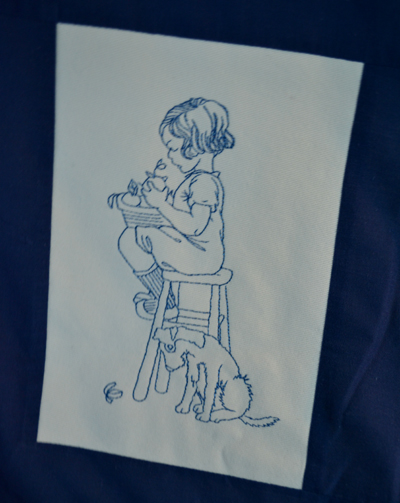
Machine embroidered quilt top (designs by Cactus Punch QLT04-redwork CD.


I compiled this information about Redwork about three years ago and credited all the e-resources used to gather this information, though some of them are no longer available and so I removed them from the resource list below. Some of you may be interested in reading more about this art form or locating old fashioned Redwork embroidery patterns and books so I have included a listing of those as well.  It is a mere sampling and there are many more wonderful sites and tutorials on line. A special thanks to the reader who asked!

Redwork History   


Note simple hand-work stitching.
Redwork is believed to have originated at the Royal School of Art Needlework in Kinsington, England in the early 1800's. In those days embroidery was part of a girl's education. The poor could use their sewing skills as paid work and the rich would use it to embellish their trousseaus.

Redwork got its name from the Turkey Red cotton embroidery thread used for this simple outline-style embroidery design.  Its name didn't just denote its color, but also the lengthy and complicated dying process that made this thread colorfast.  It was an inexpensive machine-made thread whereas other embroidery threads of that day were expensive silk threads or non-colorfast threads that would "bleed" or run.

Silly and fun designs!by Aunt Martha's Iron Transfers.
From 1860 through the 1920's this form of embroidery became very popular. It was easy and simple, making it a popular way for young girls to learn and practice their embroidery skills. Sears Roebuck and other dry good catalogs stores of the day would sell "penny squares", which were simple preprinted designs on muslin squares that sold for a penny.  For another penny, a skein of Turkey Red embroidery thread could be purchased and then these squares would be embroidered and sewn together without sashing or borders to make summer weight coverlets and spreads.  Once the squares were seamed together, the seams would be covered with a feather stitch. These summer weight spreads would simply be a "quilt top" hand-tied or tufted to a cotton backing without any batting or filling between the layers.

Redwork became so popular that magazines would provide pull out Redwork patterns to promote selling their magazines.  In 1870 iron-on transfers were developed and do-it-yourself pattern stamping kits were offered by catalog companies along with published patterns.
For the love of this Redwork Cactus CD, I bought an embroidery machine!

No color variations exist. The differences are due to my amateur photo skills.
Bluework joined Redwork in popularity in the early 20th century as it was the next color to become colorfast (indigo blue).

After 1930 synthetic dyes were manufactured in the U.S. and then a wide range of colorfast threads were available. Designs became multi-colored and the style of embroidery changed from this simple outline style to solid stitched designs.
Humpty Dumpty is one of my favorites. This pattern was from a free e-site.


Thank goodness for modern, inexpensive colorfast embroidery threads!
A renewed interest in all types of handcrafts became popular again around the American Bicentennial in 1976. Quilters were inspired by the antique Redwork quilts and were largely responsible for making it a popular art form once again. Antique Redwork quilts are occasionally found in antique stores today and such quilts are valued treasures.

Redwork Designs and Use

Redwork designs were simple, outline designs done with a basic outline stitch (AKA Kensington Stitch), and might include other simple stitches such as cross stitch, chain stitch, stem stitch, double running stitch, French knots, colonial knots, back stitch and split stitch. Eventually more fancy crazy quilt stitches were also added.

Redwork customarily is done using two strands of six stranded embroidery floss or one strand if line detail is to be added. DMC #304 or #498 are considered by some to represent the most authentic "Turkey Red" color. Bluework, greenwork and blackwork also became popular.  Some even do Redwork in purple.  Generally Redwork is done in darker thread on light colored fabric (white, muslin, tea or coffee-dyed). Now Redwork is the term used to designate the style of this basic embroidery instead of the color of the thread used.

Other tools used in Redwork embroidery include an embroidery hoop to hold the material taut and embroidery needles that have bigger eyes, making them easier to thread. The use of the thimble was thought to be quite essential for a person who stitched, though skill is needed in its use and some prefer to stitch without one.

Common Redwork style embroidery designs include but are not exclusive to vintage sorts of flowers, fruits, vegetables, historical scenes and places, children, nursery rhymes, Sunbonnet Sue, days of the week, holiday designs and even Bible verses or moral sayings about the virtues of hard work. Simple designs can be hand-drawn or copied from coloring books and can be transferred by taping both the design and material onto a window and lightly tracing the design with a pencil.

Sewing motifs are popular too. (excuse the glare from its cellophane package.

Fruits and Vegetables are common Redwork designs.


Recognize this simple heart from Raggedy Ann and Andy dolls?


Traditionally, Redwork designs were added to common household items like dish towels, pillow cases and shams, coverlets and spreads, tablecloths, luncheon cloths, decorative pillows, laundry bags, dresser scarves, antimacassars, splashes,(cloths behind a washbowl), mantel covers, quilts, aprons, appliance covers, sachet pillows and handkerchiefs.
Again this design is from the Cactus Punch QLT 4 Redwork CD. So sweet!


E-Sources of Information and Patterns and Stitching Tutorials:

www.secretsof.com/content2597
www.allsands.com/home;deocorating/redworkembroide_sdw_gn/htm
www.grandmasatticquilting.com/Redwork.htm(www.grandmasatticquilting.com/Redwork.htm)
www.redworkpllus.com/dynamic/?page= 3
www.straw.com/equilters/library/techniques/redwirj-embroidery.html
www.redwork.info/instructions.html
www.pretty.impressivestuff.com/redwork.htm

Bibliography of A few of my favorites on Redwork:

Cherished Redwork for Baby by Leisure Arts
Redwork Quilts and More by LaureneSinema
Redwork from the Workbasket by Rebecca Kemp Brent
Learn to do Redwork, 77 recreations of Antique Blocks by American School of Needlework
Blackwork by The Bee Designs, 1975.

Check out these great Redwork patterns and books:

www.imaginating.com (Let's Sew #2752 by Ursula Michael)
www.cottonpinkindesigns.com (Tea Time #E-TEA)
www.CrabappleHillStudio.com (#254 Victory Garden)
Praise Publications, 5 Main St. Ext., Plymouth, Ma 02360 (In the Garden)
Praise Publications, 5 Main St. Ext., Plymouth, Ma. (Down the Garden Path by Dottie Krueger)
www.black-cat-creations.com, (Afternoon Tea by Judy Reynolds) (tea pots)
www.black-cat-creations.com (Sadie's Keepsakes by Judy Reynolds) floral designs


Thursday, August 22, 2013

More on Crazy Quilts

Crazy quilts are among my most favorite sorts of quilts. They can be done quite spontaneously with little planning and provide the quilter a chance to display her love of stitching. I did my first crazy quilt when I was in college. Instead of using fancy materials, I simply collected discarded or donated fabric scraps from all my sewing friends, clothing tags and pieces of my favorite worn out, dated or outgrown clothes. Even a bit of my Blue Bird vest from my childhood was added to this quilt.

I simply stitched them in an overlapping and crazy fashion to a bed sheet using a whip stitch, turning  the exposed edges under as I went  and then added plenty of embroidery stitching along the seams with different weights and colors of embroidery threads!  It was fun and easy and made a great long term and inexpensive project for a young sewer, needing to practice hand and embroidery stitching.

I am still working at tying a black cotton backing to it using all a variety of colored pearl cotton threads and have tried to match these ties to the front fabrics, so as to not distract from patchwork and fancy stitching. I do  have a hard time finishing quilts as I love to start new ones! Some people have their quilts professionally quilted or tied by others as they too prefer to design and do the patchwork, than the quilting or the tying.


I did learn the hard way that crazy quilting is often done in smaller quilts and throws as when you add a backing to cover the backside of your patchwork and stitching, your quilt can become quite heavy. I was initially going to use a heavier and richer fabric for the back but then my quilt would have been too heavy to use.


My quilt was done very spontaneously with only some attempt at balancing colors and working to be sure to add a variety of materials, colors, shapes and sizes in the pieces added. Some crazy quilts are more carefully planned with subject themes executed in the embroidered details as featured in the blog, A Crazy Quilt with a New Twist, or with more conformity in the sorts of fabrics used. Whatever you prefer, anything works! Crazy quilts are fun to do as there is no mundane repetitiveness as found in other sorts of quilts where all blocks are similar or even the same. It is also a chance for us fabricaholics to enjoy the vast array of fabrics, new and old alike.

Stitched into my quilt were many memories of my life in the 60’s and 70’s. You will even note the dated "hippie LOVE" fabric. These are the details that make a crazy quilt personal to the quilter sewing them. I often took it with me and stitched on it while I sat with my family and friends to visit, or watch TV.  Quilts are treasures of memories both in the fabrics shared and used and the people surrounding us as we stitch!

Crazy quilting can be used in smaller projects. Years ago I did crazy quilted Christmas stockings that are now part of our yearly Christmas tradition. The laced trimmed ones are for the ladies and the wide cuffed ones for the men.


I have also used crazy quilt technique in designing my pincushions, and tea cozies!  For sewers that love to do embroidery work, it is a good way to use your left over material scraps and threads! You will note that I have used fancy materials as well as cottons or wools for these projects. Don’t be afraid to create your own crazy quilted pillows, bags, throws and quilts from whatever fabric you have on hand. Get loose and enjoy the process as you stitch away!

(The tea cozie and wool dressmaker/hat pincushion in this blog are for sale and may be found in my ETSY shop. Any crazy quilted smaller items may be special ordered by contacting me. They do take time to create and cost a bit more as their beauty and value is in the hand-detailed embroidery work.

Wednesday, August 7, 2013

A Crazy Quilt with a New Twist

Crazy quilts are among my favorite quilts and this year at Vermont Quilt Festival, I was particularly taken with this "Flowered Crazy Quilt" by Diane Ewald.


Usually crazy quilts are done with fancy sorts of materials like silks, satins, and velvets with fancy embroidery stitches to accent them. This one was done with a new twist: plain sorts of fabrics making the fancy stitching and embroidery “pop” all the more. The results were striking.


Its theme was beautifully hand-embroidered flowers using ribbon as well as embroidery thread and tastefully embellished with beads. Diane Ewald's hand-work is exceptional!


Her patchwork, rather uniform, though the blocks are turned many different ways, makes me think that the piecework was likely done with a special program on a fancy machine. I have a Husqvarna program that does this sort of  patchwork. Crazy quilting, however, does not necessitate having a fancy machine, or for that matter any machine as it is the richly done hand-work that makes crazy quilts so beautiful!!

In contrast, this crazy quilt displayed at the 2008 Vermont Quilt Festival demonstrates the typical sorts of rich fabrics traditionally used in crazy quilts. Here Sheila Groman's  uses applique and embroidery in her crazy quilt, entitled "Harmony" to convey her values of love, life, hope, joy, health, family, books, art, and friendship.


A religious themed crazy quilt displayed at the Maple leaf Quilter's Show at St. Joseph's College in West Rutland, 2009 again demonstrates the more traditional sort of crazy quilt done with fancy sorts of materials. Creative punch needle embroidery, fabric photo'd prayer cards, counted-thread cross stitch, and buttons as well as rich detail work done with rosary or seed beads and crosses found at a flea market embellishes this beautiful quilt making it a unique work of art.


Crazy quilts never cease to amaze and intrigue me.  They are fun to make and each becomes a personal expression of the quilter's personality and hand sewing talents.  There seems to be no limit to the endless possibilities for embellishment and design.